Onro offers end-to-end software for local courier companies, while TransVirtual stands out with the industry’s largest carrier-integration library. To go beyond marketing claims, I spent about two weeks analyzing technical documentation, deep-diving into user feedback, and comparing feature sets to see which platform truly fits different logistics models. Here is what I found.
Onro vs. TransVirtual at a Glance
| Onro | TransVirtual | |
|---|---|---|
| Starting Price | $239 / Month (1,500 Orders Included, $0.16 / Order) | $0.40 / Order (Consignment) |
| Capterra Rating | 5/5 | 4.8/5 |
| G2 Rating | 5/5 | 4.8/5 |
| White-labeling | Full (Driver app, domain, customer apps, tracking page) | Partial (Customer portal only) |
| Barcode Scanner App | Yes | Yes |
| Operational Focus | Courier-native | Freight & Carrier management |
| Carrier Integration | API-ready (build your own integrations) | Yes (+400 Integrated Carriers) |
| Best For | Same-day / Next-day / on-demand couriers | Freight / 3PL / Multi-Carrier Logistics |
| Free Trial | Available, 14-days trial of full-feature package, No credit card | No, Requires a sales meeting |
| Billing & Invoicing | Standard Invoicing / Wallet | Advanced (RCTI, Fuel Levies, Multi-Rate) |
| Real-time Dispatching | Automated Dynamic Dispatch | Planned/Manifest-based Dispatch |
| Rate-cards and Surcharges | Yes | Yes |
| DIFOT/OTIF Reporting | Standard | Advanced / KPI-focused |
| Vehicle Management | Basic | Advanced (Fuel Management, Maintenance) |
Which Courier Platform: Onro or TransVirtual?
Choose Onro if:
- You are a Domestic / National Courier: Onro is designed for national and local delivery operations. It is not designed for international freight, customs, or cross-border logistics.
- Cost-Efficiency for High Volume: Onro’s usage-based model is local couriers’ friendly, often costing less than half (~ $0.16) of the standard $0.40 per-shipment Trustvirtual fee.
- Branding is your priority: You need a fully white-labeled platform where your branding is seen by your customers and drivers.
- Auto-Dispatching is a “Must-Have”: You want software to handle job assignments automatically based on the current situation.
- You Deliver For E-Commerce/Merchants: Your business model is rush (on-demand), same-day, or next-day deliveries for online retailers.
- Cash on Delivery (COD) is standard: You need integrated wallet features to manage instant cash payments and driver reconciliations easily.
- You value Modern UI/UX: You need a simple, high-tech interface that allows you to onboard new drivers in minutes, not days.
Choose TransVirtual if:
- You use a Carrier Network: You need to outsource or partner on shipments through a massive network of +400 pre-integrated carriers.
- You offer 3PL/Fulfillment: You operate a physical warehouse and require integrated WMS (Warehouse Management System) tools.
- Billing is highly complex: You require automation for international rates, fuel levies, and RCTIs (Recipient Created Tax Invoices).
- Fleet Maintenance is a priority: You manage heavy-vehicle assets that require strict maintenance logs and safety checklists.
- Capacity Optimization is key: You move palletized freight and need to maximize every square inch of truck space.
- Multi-Carrier Workflows are standard: Your business involves frequent hand-offs between different carriers or sub-contractors.
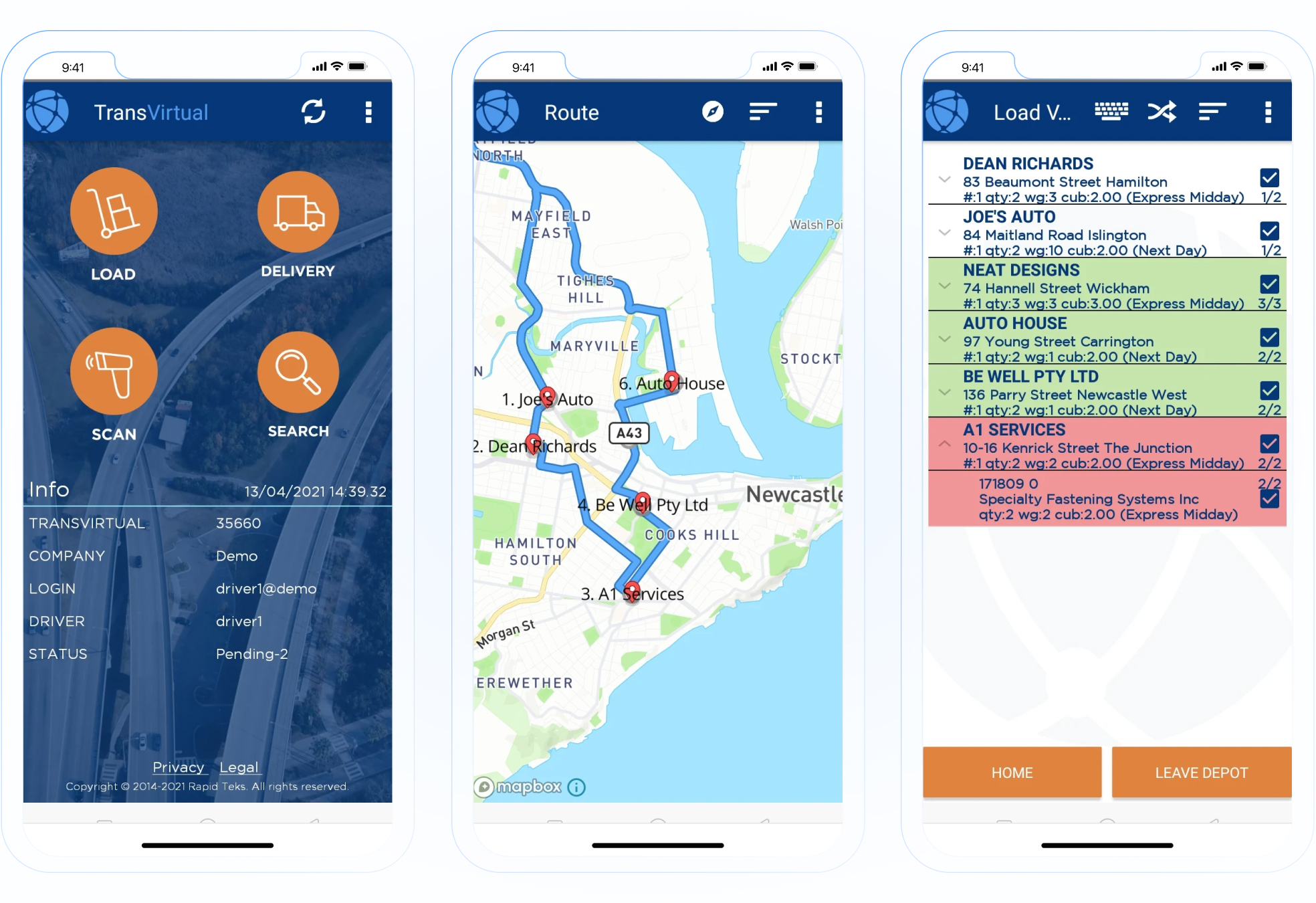
Driver App UX: A Side-by-Side Comparison
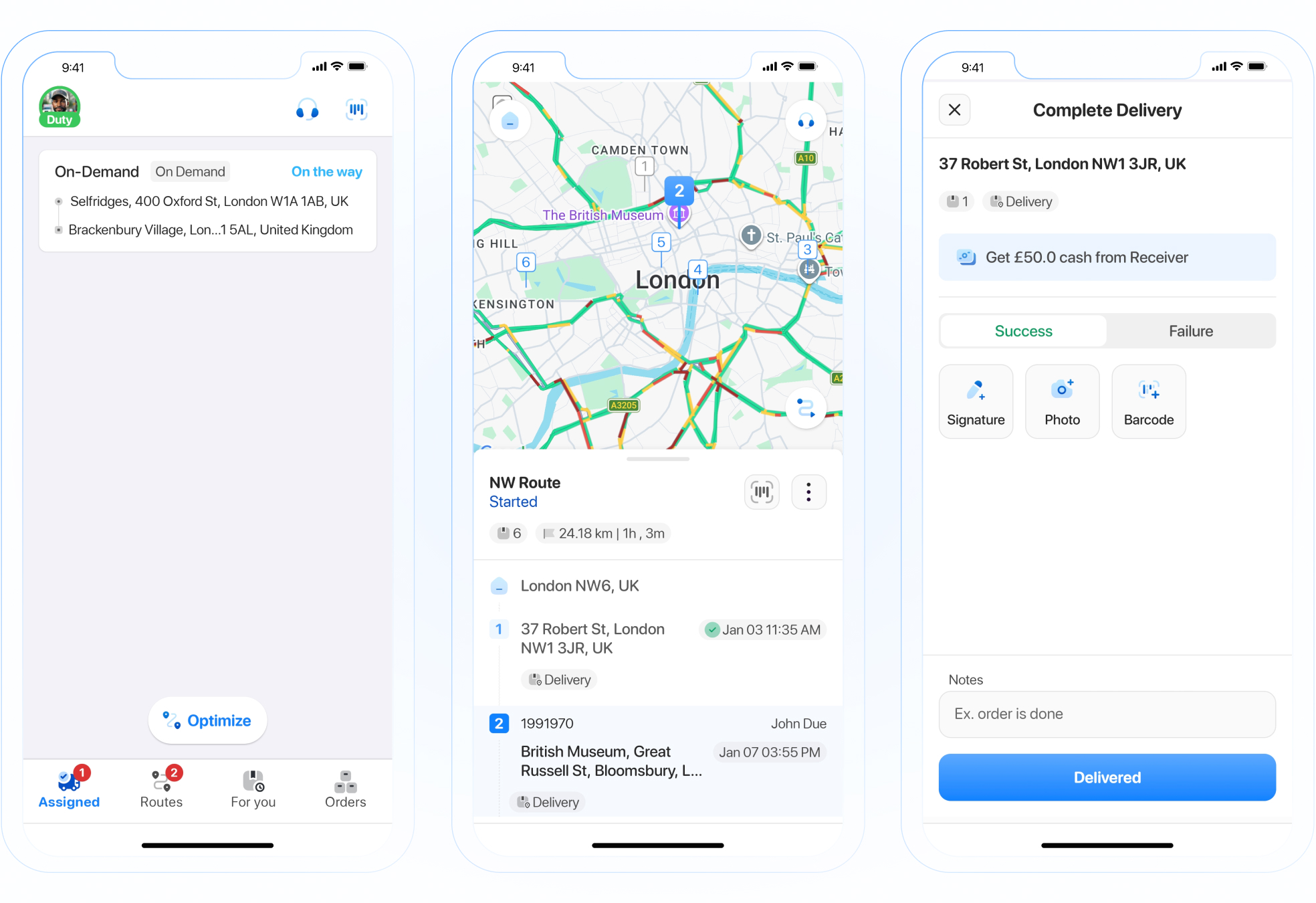
To get a true feel for how these platforms work in the field, it’s best to look at the interface your drivers will see every day. Below are the latest screenshots from the Google Play Store for both Onro and TransVirtual.
TransVirtual:
Onro:
FAQ: Onro vs TransVirtual
No. Onro is specifically designed for small-parcel, courier, and “last-mile” delivery models. TransVirtual is the better choice for freight carriers because it includes features for pallet tracking, capacity optimization, and heavy-vehicle management. If your business moves large, palletized goods, TransVirtual’s infrastructure is built to handle that complexity.
Paying $0.40 per order doesn’t make sense for most local courier companies, especially in many countries where delivery margins are tighter. Onro is much more budget-friendly for high volume because they offer discounts as you scale, rather than charging a high flat fee for every single shipment.
Automatic dynamic dispatching is an intelligent algorithm that assigns orders to the best available driver without human intervention. Unlike static scheduling, it makes decisions based on real-time data, including:
Live Location: Proximity to the pickup point.
Order Capacity: Whether the driver’s vehicle has space for the specific parcel.
Vehicle Match: Ensuring a bike isn’t assigned a large furniture delivery.
Promised ETA: Prioritizing orders that are closest to their deadline.
Final Verdict
Both platforms are strong but serve different logistics models. Onro is built for modern courier operations that prioritize automation, branding, and fast local delivery workflows. TransVirtual is built for freight-heavy businesses that require carrier connectivity and complex billing automation. The right choice depends on whether your core operation is courier-native or multi-carrier freight management.
Don’t let the $0.40 TransVirtual fee scare you if you are a 3PL; their automated fuel levy calculations and WMS integration can save more in labor hours than you’ll pay in per-order fees. If you are a delivery company, Onro’s white-labeling will make you look like a tech giant to your local clients.